

I know this is a bold statement, and maybe there will be people that will come at me for this. Hear me out though before you decide to scroll on by and consume that video of a cat that you probably want to be looking at instead.
As a therapist, I see a lot of different people, with lots of different things happening to them in their lives. And I mean lots. In addition to this, there is a lot of s**t happening to me as well.
In fact, we seem to be at a time, in whatever era we are in, maybe the AI one, when there is a LOT going on for a LOT of people.

There are those that are struggling in war-torn areas, those trying to escape those places, those who have difficulties because of their economic status, those who have struggles and challenges because of physical differences, those that are struggling because they have challenges with cognitive differences, people that have been mistreated, people that aren’t able to really “be” who they are because those around them don’t accept who that person loves, or what gender they feel they need to be.
There are those that are struggling with all of the above even; such is the intersectionality that the minority stress of one thing becomes a mishmash of many different things, all pulling inside them, and causing difficulties across many parts of their lives.
That is a lot. There is a lot happening, and I think we are missing a fundamental truth because of the stuff that is going on around us.
When the world around us feels unsafe
Not least because the power that our world wields now is in the hands of some very unstable, and slightly orange, actors in our world. That makes the predictability of what happens to us all feel like something we may no longer have the power to control.
As humans, we value our autonomy, and if those that govern us feel they are, at best, not speaking for us, or at worst, actively going against the values that we hold dear, then our sense of psychological safety is, quite rightly, rattled.
It becomes more fragile because the values that we hold dear are not being reflected in the nations we live in, or the governments that hold the power over us.
We only have so much power to change things, and those that feel the injustices in the world deeply, and that lack of autonomy even more, feel helpless with the onslaught.
And then there are the real lives that are being lost because those who hold the power are doing things in our name which, in many cases, might sicken us.
What stands out for me
Through all of this, with the individuals in therapy rooms, and the powerful men that have their fingers over the dangerous buttons in our world, there is something that stands out for me.
We have lost the capacity to both give ourselves compassion, and reach out with empathy to others so that we can truly see what the world is like for them, even though we are not living it.
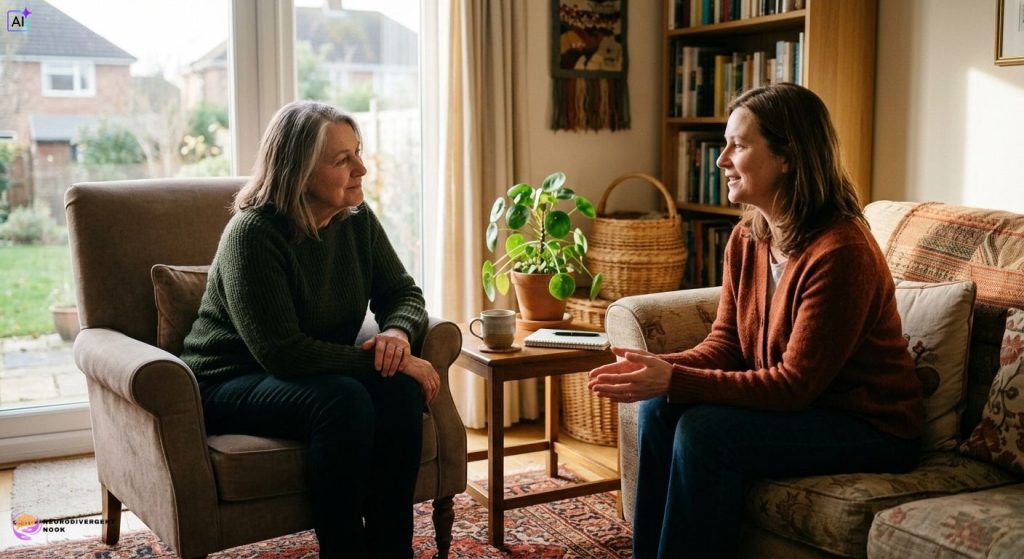
Why self-compassion can feel so hard
Turning compassion inward is a hard task, and becomes even harder if we haven’t experienced compassion from others ourselves.
The gentle hand on our arm when we make a mistake that says, it’s OK. It happens. It doesn’t make you a bad person. Mistakes are human. Mistakes happen. What matters is what we learn from those experiences, and how we REACT to those mistakes.
A small mistake, like forgetting something, doesn’t mean we are a terrible person. It isn’t a black and white situation after all.
The same is true of actions that affect others, such as the unkind things we do without thinking when we are tired, when we have had a difficult day looking after a child, or when we just need space or sensory rest.
How we react when we are told these things is what matters: do we take it on board, do we consider the other viewpoint, and do we change when we are able to do so?
If we have not seen that compassion shown to us, how do we then show that compassion to ourselves? How can we forgive ourselves for the mistakes that we have made, when we haven’t seen that modelling from others to us? And even more so, how do we not feel shame because we feel we are beyond help, or even that we are broken and somehow need fixing?
The connection between empathy and compassion
Entire nations are turning on others without compassion. How are we then to give ourselves the self-compassion that is needed to help us stop the damaging inner voice that tells us we are wrong, useless, or indeed, broken?
If we lack compassion for others, driven by the empathy we feel for those in situations different from ours, how can we even support ourselves? Compassion for ourselves starts with compassion for others.
Teaching our children, and beyond, how to be compassionate is partly because they have seen what it means from us. Yet now, we are seeing mass genocide across the globe: no compassion, no empathy, and for some nations and people, so little hope that they feel the only alternative is to risk life and limb to get out.
We talk of an oil and gas crisis. We talk of a cost of living crisis. For me, if we are not careful, we will descend into an even worse one: one which means we will all struggle. A crisis of empathy and compassion that starts with others, but will ultimately end with us.
A note on our self-compassion podcast episode
This is one of the reasons I wanted to talk about self-compassion on the Neurodivergent Nook podcast too.
This is the episode embedded from Spotify – if you prefer another player, feel free to visit my Substack, or the link with all options here.
In this episode, we explore how self-compassion is not about letting ourselves off the hook, pretending things are fine, or avoiding responsibility. It is about learning how to meet ourselves with a little more gentleness, particularly when we are overwhelmed, ashamed, burnt out, or carrying the weight of too much for too long.
For neurodivergent people especially, self-compassion can feel incredibly hard when life has so often taught us to criticise ourselves first. But that is also why it matters so much.
5 gentle ways to encourage empathy and self-compassion

From my perspective, there are some small and important ways we can start to encourage both empathy and self-compassion:
1. Pause before reacting
So often, our first response is judgement, both of ourselves and, indeed, of someone else. A pause gives us space to respond rather than react. This can be extremely hard when we are dysregulated. And it may not be possible. It is always worth bearing it in mind.
2. Get curious about what sits underneath
Stress, trauma, grief, sensory overload, shame, exhaustion, fear: all of these shape behaviour. Usually, there is more going on underneath than we first see.
3. Move away from black and white thinking
That doesn’t mean stop doing it, as it is hard for us neurodivergent individuals to do this. It means when we are able, think about the middle space, and the grey areas, rather than presuming the extremes which can be where our minds naturally, and perfectly understandably, wander.
For example, one mistake is not the same as us being a bad person, or a difficult moment is not the same as being broken.
4. Speak to yourself as you would someone you care about
Many people speak to themselves in ways they would never speak to somebody they love. Self-compassion often begins with changing that inner voice. Imagine a kind alternative, and perhaps picture them when you find yourself getting something wrong.
5. Remember that compassion and accountability can sit together
Empathy does not mean excusing harm, and self-compassion does not mean avoiding responsibility. We can be kind, reflective, accountable, and willing to repair all at once.
Maybe this sounds idealistic. Maybe it even sounds too simple for the complicated world we are living in. Empathy and self-compassion are soft options as some of those out there would think they were. Snowflakes are empathetic is the refrain I hear in the media. True boundaried empathy means that you hold individuals while still understanding them, not excusing unacceptable behaviours.
If we lose the ability to see each other clearly, and to treat ourselves with even the smallest amount of care, then the cost will not just be personal. It will be collective. Sadly, we can already see the costs of standing back playing out in the world at large, and if we have to claw this back. Empathy and compassion are the glue that holds our humanity together.
Leave a Reply