

Summary
Helen Neale and Diane Frainer (therapist and headteacher) share lived-experience insight into dyspraxia (DCD), with practical tips for parents, educators, and therapists to offer real support.
TL;DR – For those who struggle with long articles
Dyspraxia (also known as Developmental Coordination Disorder, or DCD) affects motor planning and coordination, often alongside shame, fatigue, and misunderstanding in school settings. With grace, pacing, and practical adjustments like sensory trails, typing, and movement-based learning, parents, educators, and therapists can help dyspraxic children and adults thrive on their own terms.
In a recent conversation on the Neurodivergent Nook podcast, what struck me most wasn’t the clinical detail. It was how much shame still clings to something as ordinary as getting changed for PE, holding a pen, or doing up a shirt button. So we wanted to bring that conversation here, to anyone parenting, teaching, or supporting a dyspraxic child or adult, because understanding and acceptance is what this site, and the podcast is all about.
Here is the episode on Spotify to listen too, it is available on all streaming services though, so check the other streaming services out too. We are also on Substack as well.
What is dyspraxia (DCD)?
Dyspraxia, now more formally known as Developmental Coordination Disorder (DCD), affects motor coordination and planning. Diane describes it simply: dyspraxia is often reduced to “the person that’s always clumsy” or “the person that’s got lots of bruises on their legs.” But that framing misses the bigger picture.

Dyspraxia can involve delays in crawling, walking, talking, feeding, and dressing. It can show up as difficulty judging where your body is in space, part of our proprioception. Diane herself has motor challenges, as does her husband and some of her daughters. She is not classed as dyspraxic, but her own sensory processing differences mean that she shares that “inability to understand where she is in relation to anything else,” as she put it on the podcast.
Dyspraxia frequently co-occurs with other neurodivergent conditions, including autism and ADHD, though it can also exist on its own.
Dyspraxia in real life: it’s more than just clumsiness
One of my favourite moments from recording was Diane’s story about a social worker client with ADHD who blamed her clumsiness on menopause, only for the two of them to bump heads bending down to stroke a dog minutes later. They’d never met before. “Dyspraxia,” they both said, laughing, and went their separate ways.
That story matters because it shows how normalised and invisible Dyspraxic traits can become, especially in adults who were never diagnosed as children. Diagnosis rates drop sharply in adulthood, not because the motor coordination differences disappear, but because the systems built to notice them are designed around childhood developmental milestones.
How dyspraxia shows up in schools
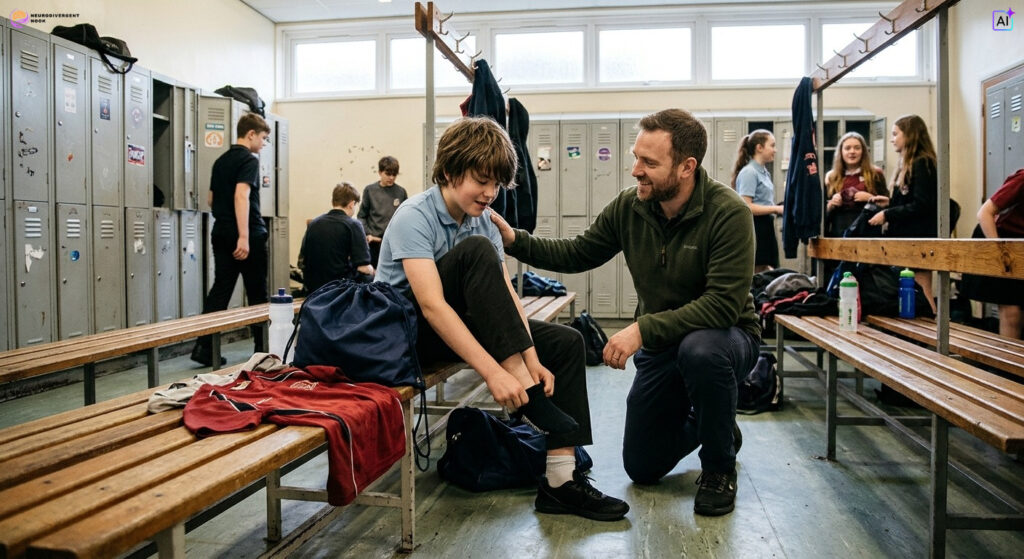
Diane spent nearly 28 years in education, and she’s seen dyspraxia misread as laziness or defiance more times than she can count. The clearest example she gave me was the PE changing room.
Dyspraxic teenagers are often the last to get changed before PE, then the last to get changed after it, which means they walk into their next lesson late. They get told off for lateness. They get told off for an untucked shirt. They get told off for a tie they physically cannot manipulate with the coordination PE demands. As Diane put it, these are young people “who already feel enough shame because they might not be great at doing a particular sport on PE that day,” before an adult adds more shame on top for something they cannot simply speed up.
Writing tasks carry a similar weight. Dyspraxia can affect handwriting speed, legibility, and the sheer physical effort required to hold a pen correctly. In one training session, Diane had to do up buttons wearing thick oven gloves to simulate what fine motor tasks feel like with dyspraxia. “It was impossible,” she said. That’s the gap between what schools expect and what’s physically achievable without support.
Tips for parents: supporting your child at home
If you’re parenting a dyspraxic child, here’s what Diane and I would want you to know:
- Build in pacing, not pressure. Diane told her daughters “it’s okay, we don’t have to be the first person to get dressed in the mornings.” Removing the race removes a layer of anxiety.
- Name the energy cost. Motor tasks that look simple can be genuinely exhausting for a dyspraxic child. If your child seems drained after a day involving PE, handwriting, or a lot of movement, that fatigue is real and deserves recognition, not dismissal.
- Protect comfort over competition. Encourage activities your child enjoys and feels capable in, whether that’s running, swimming, or something entirely sedentary. Diane found running and netball worked for her, despite tripping over her own feet everywhere else.
- Create a neurodivergent-affirming home. Diane described growing up in a family “that embraces that and understands that,” which let everyone be themselves without constant correction.
Tips for educators: creating a dyspraxia-friendly classroom
Teachers carry enormous responsibility here, often with limited resources. A few practical shifts can make a genuine difference:
- Offer time and privacy around changing for PE, rather than treating lateness as a discipline issue.
- Reduce the handwriting burden where possible. Touch-typing programmes and laptop access can transform a dyspraxic student’s relationship with written work. As I said to Diane, “what is stopping us from doing that for children with dyspraxia,” given how rarely most adults handwrite anything now.
- Rethink early years provision. Diane is candid that schools place “far too great an expectation” on young children to sit and write. Threading, colouring, forest school, sand and water play, and clay all build fine motor skills through play rather than pressure.
- Watch for secondary school fragmentation. A primary-aged child has one teacher who understands their context. A secondary student might see ten or fifteen adults in a day, each without that same background knowledge. Build systems so that understanding travels with the student, not just with one teacher.
Tips for therapists: understanding context and co-occurring conditions
As therapists, our job isn’t just to recognise dyspraxic traits in isolation. It’s to understand how they interact with everything else a person is carrying:
- Ask about occupational therapy and physiotherapy wait times. Diane noted referral pathways are “a really, really challenging process,” so families often need support navigating long waiting lists, not just a diagnosis.
- Screen for co-occurring neurodivergence. Dyspraxia frequently sits alongside autism and ADHD. Diane’s own dyspraxia was often “the less of the needs” presenting alongside her autism and ADHD, which meant it got less direct support than it deserved.
- Consider adult presentations. Adults rarely get diagnosed with dyspraxia, yet the traits don’t disappear. Fatigue, joint hypermobility, and proprioceptive differences in adulthood are all worth exploring through a dyspraxia-informed lens.
- Validate the emotional layer. Shame around motor coordination doesn’t stay confined to childhood. It often resurfaces in adult contexts like gyms, workplaces, or social situations involving physical coordination.
Practical interventions that work

A few specific, evidence-informed approaches came up repeatedly in our conversation:
- Sensory trails. Diane ran these as a headteacher: early-morning sessions where small groups of children did activities like throwing beanbags into buckets and cross-midline exercises (touching the left hand to the right knee and vice versa). The goal was to get children into a calm, alert state ready for learning, and the results, she said, were “fantastic” for both motor skills and social-emotional development.
- Typing as an alternative to handwriting. Typing often requires less complex fine motor coordination than handwriting. Offering laptops or touch-typing instruction can relieve pressure without removing a student’s ability to express their ideas.
- Movement-based and play-based early years learning. Threading, clay, water play, and forest school all build the same muscles and coordination skills that formal handwriting instruction tries to force too early.
- Reasonable adjustments around transitions, particularly PE changing times, reduce the risk of children being punished for something outside their control.
We are not all made the same: embracing neurodivergent difference
There’s a moment in our conversation that’s stayed with me. A gym trainer corrected the angle of Diane’s foot during an exercise, not realising that angle was how her body naturally compensates for dyspraxia and hypermobility. Diane tried the “correct” position for three seconds and immediately felt it was wrong for her body.
That’s the heart of what I want educators, parents, and therapists to take from this: when a system (psychiatry, education, fitness, or otherwise) applies a single standard to every body and every brain, it inevitably fails the people who don’t fit that mould. Dyspraxic children aren’t failing to meet a standard. The standard often fails to account for how their bodies and brains actually work.
More understanding, more grace
If there’s one thing Diane and I kept returning to, it’s curiosity. Curiosity about why a child is struggling, rather than assumptions about what they should already be able to do. Curiosity opens the door to imagination about support, and imagination opens the door to genuine change.
Dyspraxic children and adults don’t need to be fixed into a faster, neater, more coordinated version of themselves. They need grace, pacing, and practical adjustments that meet them where they are. If you’re a parent, educator, or therapist reading this, you already have more power to offer that grace than you might think.
If this resonated with you, listen to the full conversation with Diane on the Neurodivergent Nook podcast, where we go even deeper into lived experience and practical support.
Frequently asked questions
What’s the difference between dyspraxia and DCD?
Dyspraxia and Developmental Coordination Disorder (DCD) refer to the same condition. DCD is the more formal clinical term, while dyspraxia remains the more commonly used everyday word.
Can adults have dyspraxia if they weren’t diagnosed as children?
Yes. Diagnosis rates are much lower in adults because assessment pathways are built around childhood developmental milestones. Many adults, like Diane, live with undiagnosed or late-diagnosed dyspraxia alongside other neurodivergent traits.
Does dyspraxia always occur alongside autism or ADHD?
No. Dyspraxia can occur on its own, though it frequently co-occurs with autism, ADHD, and other forms of neurodivergence.
Is typing a legitimate alternative to handwriting for dyspraxic students?
Yes, for many students. Typing often demands less complex fine motor coordination than handwriting, and touch-typing programmes can reduce both physical strain and the shame some students feel about their handwriting.
What are sensory trails and do they help with dyspraxia?
Sensory trails are structured early-morning interventions involving activities like beanbag throwing and cross-midline exercises. Schools that run them, including Diane’s former school, report meaningful improvements in motor coordination and in students’ social and emotional readiness for learning. However, it IS important that they are done not to change the child, but to support them, with children’s buy in. It needs to be a collaborative process.
Leave a Reply