
We have another podcast with this one talking about masking – do have a listen, and we have written this article to accompany it too.
Listen on YouTube:
Listen on Spotify:
Masking can look invisible from the outside. A child gets through the school day, then falls apart at home. An adult seems chatty, capable and “fine”, then spends the next day exhausted, anxious or shut down. Someone may look like they are coping well, while inside they are running through scripts, monitoring every movement, and trying hard to be the version of themselves that feels safest or most accepted.
For many neurodivergent people, masking is not simply “adapting” or being polite. It can be a full-body, full-brain effort to survive in spaces that do not feel designed for us. That effort comes at a cost. Masking is effectively a survival mechanism so we feel, as neurodivergent people, accepted. It is far beyond what adapting to “fit-in” would look like you neurotypical people. We all change so we can be more accepted. The difference for those of us that are neurodivergent is the huge cost, and cognitive load that comes with masking.
In this post, we’ll look at what masking is, why neurodivergent people do it, and the mental health impact it can have. We’ll also share five gentle tips to support unmasking in a way that feels safer, kinder and more realistic. Because unmasking is not a performance, and it is not a race. It is personal, uneven and deeply shaped by safety.
What is masking?
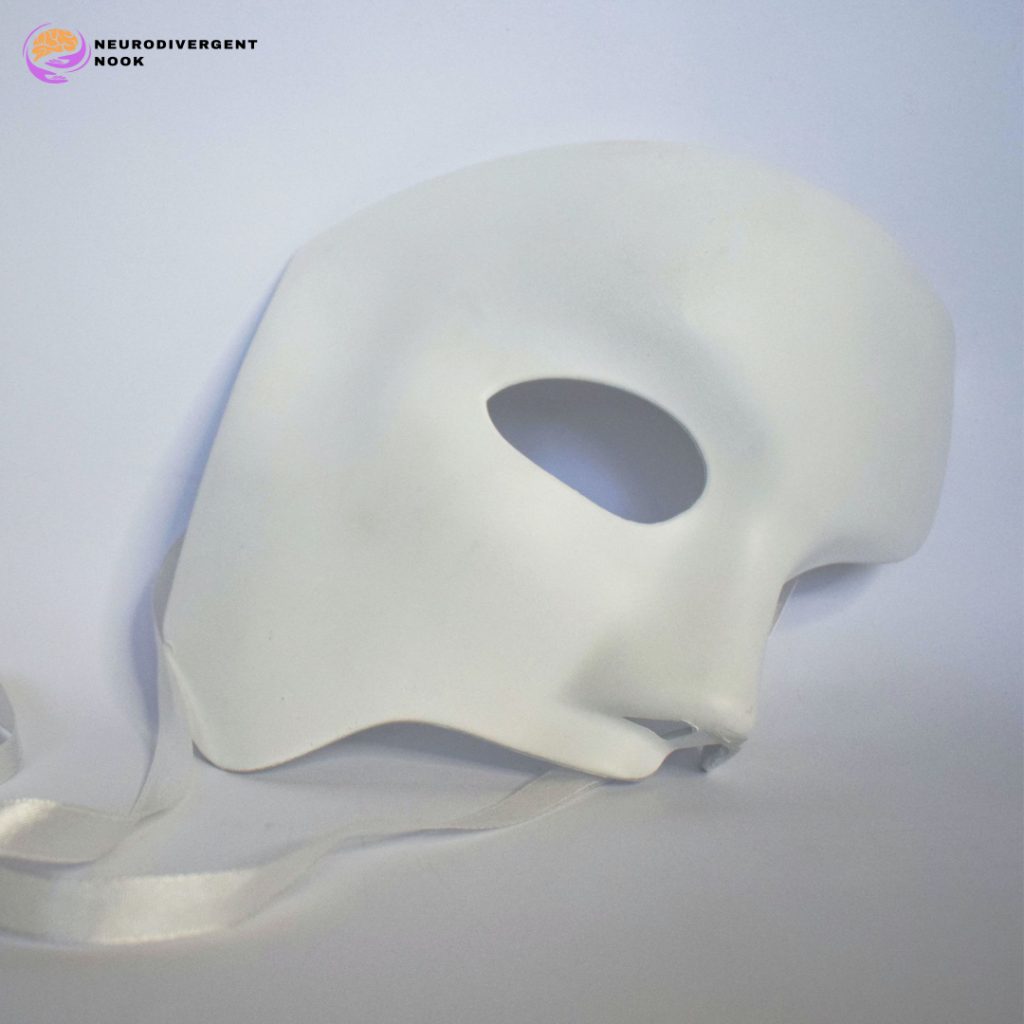
Masking is when a neurodivergent person hides, suppresses or changes parts of themselves in order to fit in, stay safe, avoid judgement, or meet other people’s expectations.
That might include, but it is far from limited to:
- Forcing eye contact,
- Scripting conversations in advance,
- Copying other people’s facial expressions or tone,
- Hiding stimming, and stimming can be many things, a repeated action (running hands through sand), flapping hands, watching the same film over and over, pacing, and so on,
- Sitting still when your body needs to move,
- Pushing through sensory overload,
- Pretending to understand social rules that do not come naturally, and
- Acting “calm”, “easy-going” or “professional” when you are actually overwhelmed
Some people are very aware that they mask. Others only realise later in life that they have been doing it for years.
Masking can happen consciously, where you know you are putting something on for a situation. It can also happen almost automatically, especially if you have spent years learning that certain parts of you are “too much”, “too loud”, “too sensitive” or “not quite right” according to societal expectations.
Why do neurodivergent people mask?
Most neurodivergent people do not mask because they want to. They mask because it has helped them cope. It has helped them to be accepted by those around them.
Masking may develop as a response to:
- Bullying or rejection,
- Pressure to be more neurotypical,
- School environments that punish difference,
- Workplaces that reward conformity,
- Family expectations,
- Fear of being misunderstood, and
- Previous experiences of shame, criticism and rejection.
For some, masking starts very young. A child may learn quickly that moving, humming, flapping, asking too many questions or needing extra support gets noticed in ways that do not feel kind. So they hold it in. They get through the day. Then they collapse once they are home.
For adults, especially late-diagnosed adults, masking can be tied up with years of trying to make sense of why life feels harder than it seems to be for other people. Many have spent decades performing competence while privately struggling with anxiety, overwhelm and exhaustion.
The cost of masking
Masking can sometimes help someone get through a social event, a work meeting or a school day.
The cost of masking in these circumstances can be emotional, cognitive and physical.
Exhaustion and burnout
Masking uses a huge amount of energy. Constantly monitoring your body language, tone of voice, facial expressions and responses is incredibly tiring. Add sensory overload, social pressure, trying to meet expectations, and the result can be total depletion.
This is one reason many neurodivergent people feel wiped out after things that others may see as ordinary, such as a day at school, a meeting, a family gathering or a trip into town.
Over time, that strain can contribute to burnout. Neurodivergent burnout often involves deep exhaustion, loss of functioning, reduced tolerance, and feeling unable to keep up with everyday demands. Masking is one of the key reasons why neurodivergent people have fluctuating capacity for tasks that they may have been able to do from one day to the next. The level of energy we have determines whether we have the capacity for a specific skill. Masking strips away our energy.
Anxiety and cognitive overload
Masking is often linked to anxiety. You might rehearse conversations before they happen. You might run through what to say if you bump into someone unexpectedly. You might spend the journey to an event trying to get the “right” version of yourself ready.
That level of mental planning creates an enormous cognitive load. It can leave very little room for anything else.
Grief and loss of identity
For many late-diagnosed adults, realising you have masked for years can bring up grief. You may look back at your younger self and wonder how much energy you spent trying to be acceptable. You may feel sadness for the child or teenager who did not feel safe enough to just be.
It can also stir up difficult questions about identity. Who am I when I am not performing? Which parts of me are natural, and which were shaped by survival? That uncertainty can feel unsettling, even when diagnosis or self-understanding brings relief.
Strain on relationships
Unmasking can change relationships. Sometimes people respond warmly and with understanding. Sometimes they do not.
That can be painful. You may hope that people who have known you for years will welcome a more authentic version of you. But not everyone is comfortable when the mask shifts. Some relationships may deepen, while others may feel less secure.
There can be grief in that too.
Unmasking is not always safe
Before we talk about tips, this matters: unmasking is not always safe or possible everywhere.
Not every environment is accepting. Not every workplace understands. Not every family member responds well. Some neurodivergent people also face extra risks because of racism, ableism, sexism, transphobia, poverty or trauma. Intersectionality has an impact on all of us, and if we are neurodivergent, the other minority groups we might belong to, and the predjuidices that exist for those, can make unmasking even more difficult. Safety always matters more than the idea of being fully unmasked at all times.
You do not have to unmask everywhere to be valid. You do not have to earn support by being visibly distressed. And you do not have to force authenticity in spaces that feel unsafe.
Unmasking can be small, gradual and selective.
1. Start by noticing, not judging
If you want to unmask more, the first step is not to rip everything off at once. It is to notice.
Try asking yourself:
- When do I feel most tense or “on”?
- Who do I script around?
- Which parts of myself do I hide?
- What do I stop myself doing in public?
- When do I feel most like myself?
You may notice that you mask differently in different places. Work might need one version of you. Family another. Friends another. That is not failure. It is information.
Gentle awareness can help you understand your patterns without shaming yourself for having them.
2. Give yourself permission to meet your needs
A lot of masking involves suppressing needs. So unmasking often begins with letting those needs matter.
That might look like:
- Wearing noise-cancelling headphones,
- Taking breaks before you hit overload,
- Moving your body when you need to,
- Using fidgets,
- Stimming openly in safe spaces,
- Saying no to plans,
- Leaving early, and
- Asking for written information instead of verbal instructions.
These things are not indulgent. They are support.
If you are late-diagnosed, this can feel especially emotional. You may have spent years pushing through, minimising your difficulties or assuming everyone finds it this hard. Giving yourself permission now can feel both freeing and sad. That is okay.
3. Build a small circle of safe people
Unmasking often needs safety before confidence.
Think about who makes it easier to exhale. Who lets you pause, move, stim, ramble, go quiet or change plans without making you feel difficult? Who does not need you to perform being okay?
You do not need a huge group. Often, a small trusted circle matters more.
Safe people might include:
- A close friend,
- A partner
- An online neurodivergent community,
- A therapist or counsellor, or
- Another neurodivergent person who “gets it.”
Being able to unmask with even one person can make a big difference. It reminds your nervous system that connection does not always have to come through effort and self-erasure.
4. Go at your own pace
There is a lot of pressure online to “just be yourself”, but in real life, unmasking is rarely simple.
Some days you may feel able to stim more, speak more directly or drop the social script. Some days you may not be able to mask because you are tired, vulnerable or in a demanding setting. We go at our own pace, in our own way, with the capacity, and the contexts that we have.
Unmasking is not all or nothing. It can sound like:
- “I can do one less layer of pretending today.”
- “I can leave this event before I crash.”
- “I can just hum at home.”
- “I can stop forcing eye contact and look away now.”
- “I can admit I’m overwhelmed.”
Small changes count. Slow changes count. Survival counts too.
5. Support children by looking beneath behaviour
Children mask as well, including boys, girls and children whose neurodivergence may not yet be recognised. Some children hold it together all day in school and then unravel at home. That unravelling is not bad behaviour. It is often the release that comes after too much effort. We need to show curiosity with our children.

If a child seems to explode after school, like a coke bottle that’s been shaken before you open it, it may help to ask:
- What has the day demanded of them?
- Were they coping, or masking?
- Did they have enough sensory breaks?
- Were they confused by social rules?
- Were they using all their energy to hold themselves in?
Children need places where they can safely move, stim, rest, make noise, and recover. They need adults who are curious rather than punitive.
When we only focus on the behaviour we can see, we miss the strain underneath it. When we understand masking, we are more likely to respond with compassion.
A final thought on masking and mental health
Masking can help neurodivergent people get through a world that often asks too much of us. But the cost can be steep: exhaustion, burnout, anxiety, grief, confusion, and the painful feeling of being disconnected from yourself.
If any of this feels familiar, you are not broken. You have very likely been coping in the ways available to you.
Supporting unmasking is not about becoming a whole new person overnight. It is about making a little more room for who you already are. It is about safety, self-understanding and gentleness. It is about noticing where the cost has been too high, and slowly finding ways to carry less of it.
You are allowed to take your time with that.
Leave a Reply